Alberta’s Sovereign Guns Refuse $22 Million Recall Race
The Canadian firearms debate has entered a new phase of confusion and open political conflict, with lawful gun owners caught between contradictory messages from Ottawa and Alberta. On one hand, the federal government has formally launched the “Assault-Style Firearms Compensation Program”, setting clear deadlines for declaration, compensation, and eventual disposal or deactivation of thousands of newly prohibited firearms. On the other, Alberta Premier Danielle Smith has publicly asserted that her government will use the Alberta Sovereignty Within a United Canada Act to refuse enforcement of the federal gun seizure program and to protect firearms owners from what she characterizes as improper prosecution.
The result is a legal and political fog that leaves individual Possession and Acquisition Licence holders uncertain about which authority ultimately governs their rights and obligations.
The federal position is laid out in stark bureaucratic detail in the notice sent to all valid PAL holders. Since May 2020, more than 2,500 makes and models of firearms have been classified as prohibited, including widely owned platforms such as the AR-15. Ottawa’s message is consistent and procedural. If you own a prohibited firearm, you must declare it during the national declaration window opening January 19, 2026, and closing March 31, 2026. Compensation may be available on a first come, first served basis, subject to funding. An amnesty remains in place until October 30, 2026, after which continued possession becomes a criminal offence unless the firearm has been surrendered, deactivated, or otherwise lawfully disposed of.
The notice goes out of its way to emphasize that while participation in the compensation program is voluntary, compliance with the law is not. It also explicitly warns Alberta and Saskatchewan residents to consult provincial authorities for any additional rules that might affect participation. That sentence, likely intended as a routine disclaimer, now reads like an acknowledgment of a brewing intergovernmental showdown.
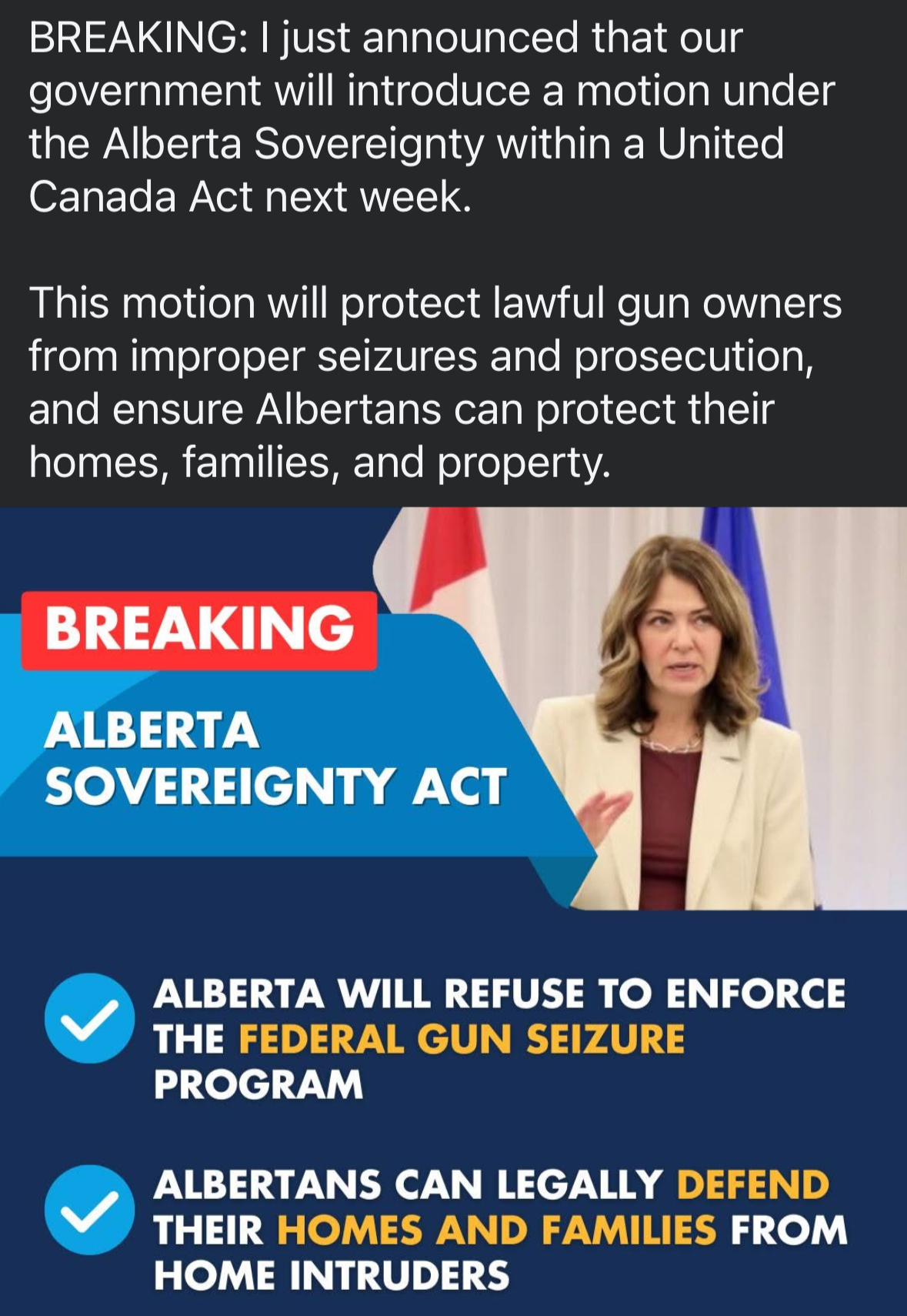
Premier Smith’s social media announcement escalated that showdown into the public arena. In a widely shared post, she declared that Alberta would introduce a motion under the Alberta Sovereignty Act to refuse enforcement of the federal gun seizure program. The accompanying graphic went further, asserting that Albertans can legally defend their homes and families from intruders, a claim that critics say oversimplifies and potentially misrepresents Canadian self-defence law. Supporters, however, see the message as long overdue political pushback against Ottawa’s firearms policies.
Firearms advocacy groups such as the National Firearms Association have amplified Smith’s stance, arguing that Alberta is acting within its constitutional rights to shield lawful gun owners from federal overreach. From this perspective, the buyback program is framed not as public safety policy but as confiscation of private property from vetted, licensed citizens. The Alberta government’s rhetoric resonates strongly in rural communities where firearms ownership is normalized and distrust of federal regulation runs deep.
Yet constitutional reality complicates the narrative. Criminal law, including firearms classification and prohibition, falls squarely under federal jurisdiction. Provinces control the administration of justice and policing priorities, but they cannot nullify federal criminal statutes. Even if Alberta directs provincial agencies not to assist in enforcement, federal law remains in force. The Royal Canadian Mounted Police, operating under federal authority, may still act. Courts may still prosecute. Amnesty deadlines do not change because a province objects to them.
This is where confusion becomes risk. A PAL holder in Alberta may reasonably ask whether to follow Ottawa’s instructions or trust the premier’s assurances. Declaring a prohibited firearm could feel like surrendering leverage in a political fight. Failing to declare could result in criminal liability if provincial resistance falters or if enforcement resumes under a different government. The federal notice is explicit that possession after October 30, 2026, will be noncompliant. Alberta’s messaging does not, and arguably cannot, offer a legally binding guarantee against that outcome.
There is also a practical contradiction. The federal program encourages early declaration to improve the chance of compensation. Alberta’s stance encourages delay, resistance, or non-participation. Gun owners must weigh financial loss against legal exposure, all while politicians argue jurisdictional theory on social media.
Ultimately, this conflict highlights a deeper fracture in Canadian federalism. Firearms policy has become a symbolic battleground for broader grievances about regional autonomy, urban versus rural values, and trust in institutions. For individual gun owners, however, symbolism offers little protection. They are left navigating a maze of statements, deadlines, and political promises, knowing that when amnesty ends, courts will not be swayed by Facebook posts or provincial press releases.
Until the conflict is resolved through legislation, litigation, or political retreat, Alberta firearms owners remain suspended between two governments telling very different stories about the same law, and bearing all the risk if they guess wrong.