APP’s Jeff Rath: Reprehensible, Scandalous, Outrageous.
Originally published in Members News March 21 2026
That's what a federal judge called Jeff Rath's conduct.
He's one of the separatist leaders.
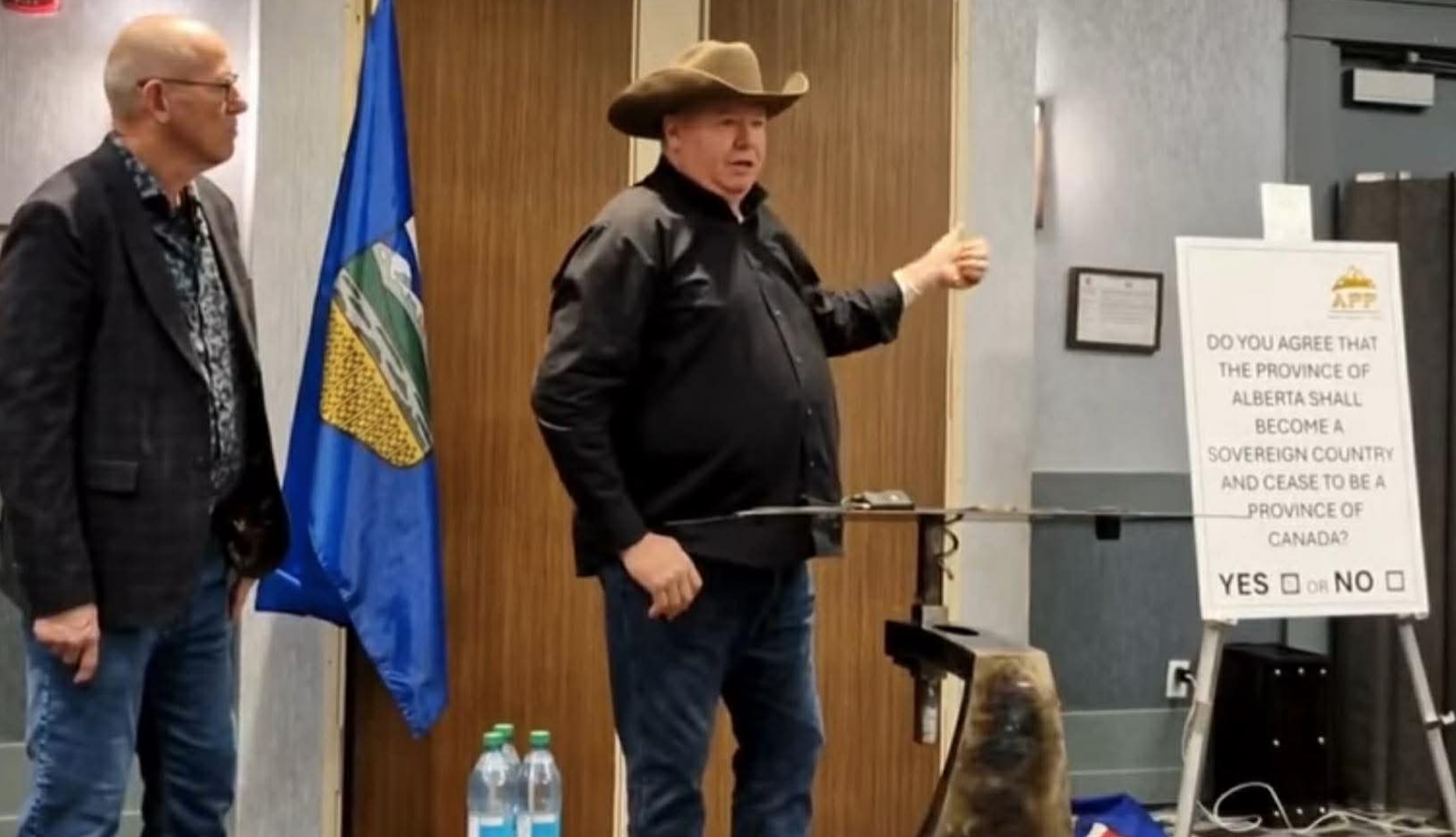
Jeff Rath is on the right with the referendum question. Courtesy of Maple and Mountain Youtube channel
Jeff Rath has been practicing law for decades. His firm's website lists some of the most important Aboriginal rights cases in Canadian history - cases like R. v. Sparrow, Delgamuukw v. British Columbia, Haida Nation v. British Columbia, and Tsilhqot'in Nation v. British Columbia. These are landmark decisions that helped define the relationship between the Crown and Indigenous peoples.
But
Those cases were about First Nations fighting the Crown for recognition of their rights. The cases we're about to talk about are about First Nations fighting their own lawyer - Jeff Rath - over his fees and his conduct.
From APP website
The Alberta Prosperity Project (APP) is the group pushing for Alberta to leave Canada and become its own country.
Rath is one of its co-founders and most visible leaders.
He's been front and center in meetings with Trump administration officials, talking about everything from a $500 million (or is it billion?) line of credit from the US using Alberta's resources as collateral to U.S. recognition of an independent Alberta.
“Financial Backstop: A $500 billion line of credit, collateralised by Alberta’s oil and gas reserves and backed by the U.S. Treasury, to provide leverage in negotiations with Ottawa, strengthen Alberta’s negotiating position post-referendum, and protect against potential fiscal retaliation. Feasibility studies are underway.”
Rath presents himself as a champion of freedom and a key player in Alberta's future as a representative of the APP. His personal professional record - the cases where he was the one in charge - tells a very different story. Critics say before people think about supporting the APP, they should know who they're getting into bed with.
A Record of Misconduct and Serious Allegations
Jeff Rath has been practicing law for decades. He's highly educated. He knows the rules. But over and over, courts have found that his work falls short - and in some cases, that his conduct was downright shocking.
Stoney First Nation: The Case That Started It All
The earliest documented example of this pattern goes back to 2010.
In December of that year, two chiefs of the Stoney First Nation signed a fee agreement with Rath to handle a judicial review in Federal Court. The problem? They didn't have the authority to do so.
Under the Indian Act and the Stoney Nation's own financial policies, any agreement to hire a lawyer and spend band money required a resolution passed by the full Tribal Council. No such resolution existed. Rath knew this - he was told directly on the day the agreement was signed that a band council resolution would be needed.
Despite this, Rath went ahead. He submitted nearly $295,000 in legal bills over the next year, paid out through a series of $20,000 cheques.
When the Tribal Council finally passed a resolution in July 2011 explicitly telling Rath to stop representing them and to abandon an appeal, Rath ignored it. He filed a motion for a stay anyway, telling the court there was "uncertainty" about his representation.
In May 2013, a Queen's Bench judge ruled the retainer agreements were "invalid" and "of no force and effect." The judge found that Rath was "willfully blind" to the obvious problems and that the two chiefs had no authority - actual or apparent - to bind the Nation.
This case matters because it shows the pattern started early. Long before the multi-million dollar contingency fees, Rath was already entering into questionable retainers with First Nations, ignoring clear warnings, and continuing to act even after being told to stop.
Sturgeon Lake Cree Nation: A $28 Million Fee That Got Thrown Out
Rath represented the Sturgeon Lake Cree Nation for 14 years. For most of that time, he billed them by the hour like any other lawyer. But in 2014, with a major claim against the government close to settlement, Rath switched the First Nation to a contingency fee agreement - meaning he'd take a percentage of whatever they won.
2017 Settlement: $142.7 million.
Rath's fee: $28.57 million.
When the First Nation's new lawyers looked at the agreement Rath had written, they found serious problems. The court agreed. In May 2024, a judge ruled the agreement was unenforceable because it didn't follow basic rules meant to protect clients. The Court of Appeal upheld that decision in early 2025.
A client that trusted him for 14 years ended up in court fighting to get back nearly $29 million - because their own lawyer didn't follow the rules.
Mikisew Cree First Nation: Another Agreement, Another Failure
Around the same time, Rath signed a similar deal with the Mikisew Cree First Nation.
Same kind of claim. Same problems.
Rath failed to serve the signed agreements on his own client within the 10 days required by law. When he finally sent them - two and a half months late - the cover letter didn't even mention that the clock was now ticking on their right to cancel.
The Court of Appeal ruled in April 2025 that the agreements were unenforceable. The judges made clear that these rules aren't just suggestions - they're there to protect people.
Tallcree First Nation: $11.5 Million for "Minor Negotiations"
Rath signed a 20% contingency deal with Tallcree First Nation in 2015 when the nation was in economically dire straits as described in paragraph 9 of the court’s decision.
When the claim settled for $57.6 million, Rath's fee came to $11.5 million.
The problem? The work amounted to filing a claim, sending a three-page settlement letter, and what a court later called "minor negotiations." At normal hourly rates, Rath's own time estimate valued the work at roughly $391,900 - about 3% of what he tried to collect.
An Alberta court reduced the fee to $3 million. Rath fought all the way to the Supreme Court of Canada, which refused to hear his appeal in March 2023.
After losing at every level, Rath raised a new argument in June 2024: the $8.5 million refund shouldn't go to the Band at all, but to individual trust beneficiaries. A judge called his timing "regrettable" - Rath only advanced this after the main decisions were already against him. The money was eventually ordered returned through the Trust, but the point stands: Rath fought every issue to the bitter end, even after losing the main fight.
Moosomin First Nation: "Reprehensible, Scandalous, and Outrageous"
This case is different from the others. It's not about a contingency fee agreement. It's about what Rath did after being fired.
The Moosomin First Nation had a long-running treaty claim against the Crown. Rath was their lawyer for years. In November 2022, Moosomin fired Rath and hired a new law firm.
Instead of handing over the file and moving on, Rath launched a multi-pronged legal attack. He filed a motion asking the court to reinstate him (which he later abandoned). He filed a separate application accusing the new lawyers of conflicts of interest, false representations, and even suggesting they had offered "secret commissions" to Moosomin's Chief and Council. He started a separate lawsuit in Alberta repeating the same allegations.
Most relevant to the costs order: during cross-examinations of the new lawyers, Rath's team asked 161 questions that the new lawyers refused to answer. Rath then filed a motion to force them to answer.
In January 2024, a judge upheld all 161 refusals. The judge found the questions were legally irrelevant, argumentative, and an abuse of process. The judge later had to decide who should pay for this failed motion.
Jeff Rath - Courtesy of Maple and Mountain Youtube channel
In July 2024, a Federal Court judge issued a costs decision with harsh words. The court found that Rath was pursuing a strategy "to demean, undermine and embarrass" the new lawyers. The court noted that Rath had made serious allegations of criminal conduct against them but had never substantiated any of them before any court or tribunal.
The judge ruled that Rath's conduct was "reprehensible, scandalous, and outrageous" and ordered him to pay solicitor-client costs—the harshest cost penalty available, meaning he had to cover the other side's actual legal bills.
An application for leave to appeal by Rath’s company was denied in March 2025
Law Society Misconduct Hearing re Thunderchild First Nation
June 2025 Rath admitted to professional misconduct in a case involving the Thunderchild First Nation. He failed to transfer a client file after being fired, and he misled the court by showing up to a hearing as if he still represented them. The Law Society issued a reprimand and ordered him to pay $10,000 in costs.
Law Society Misconduct Hearing re Goodswimmer
November 2025 The Goodswimmer litigation also caught up with Rath in 2025. That case - involving the Sturgeon Lake Cree Nation's failed attempt to reopen a 1990 treaty settlement - had already resulted in a 2022 court decision finding that Rath (in a supervisory role) and his co-counsel engaged in serious misconduct: bringing meritless stay applications, repeatedly delaying proceedings, and filing affidavits late or during hearings.
Rath admitted before the Law Society that under his supervision, legal steps were taken that were "clearly without merit" and that unreasonably delayed court proceedings. He was reprimanded and ordered to pay $800 in costs.
Law Society Misconduct Hearing re Threats to Charge Prime Minister et al With Murder
In January 2026, Rath faced a Law Society hearing for sending letters threatening to lay murder charges against the Prime Minister and the Chief Public Health Officer over COVID-19 vaccines. He wrote that if any child died from vaccines, he would pursue charges of first-degree murder. At the hearing, he argued he was acting as a private citizen, not a lawyer. A decision is pending.
What This Pattern Reveals
2013 A court already ruled that Rath had entered into an invalid retainer with the Stoney First Nation, ignored warnings about proper authority, and continued acting after being told to stop.
March 2018 Both Tallcree and Sturgeon Lake First Nations filed applications to review Rath's fees - within weeks of each other. Rath was on notice that his contingency fee model was being challenged.
September 2020 A judge in the Tallcree case ruled against him, slashing his fee by more than 70% and calling the work "minor negotiations." Rath now had a clear court ruling telling him his approach was problematic.
2019 and 2020 Right in the middle of all this he was signing new contingency deals with the Mikisew Cree First Nation.
Using the same kind of agreements.
Making the same kinds of mistakes.
Leaving the same kinds of openings for courts to later tear them apart.
Any halfway competent lawyer, after getting word that one of their fee agreements was being challenged, would sit up and pay attention. They'd go back to the rules. They'd make sure every requirement was met. They'd do everything by the book so the next time a court looked at their work, there'd be nothing to criticize.
Rath did the opposite. He didn't learn. He didn't adjust. He just kept going.
That's not incompetence. That's something else.
The Washington Meetings: Big Promises, No Proof
Rath has been busy in Washington. He claims to have met with Trump administration officials multiple times. He talks about a $500 million (billion?) loan to help Alberta transition to independence. He talks about the U.S. exchanging every Albertan's Canadian dollars for U.S. dollars at par. He talks about the U.S. recognizing Alberta sovereignty right after a referendum.
But here's the thing: nobody can prove any of this actually happened.
The State Department says no senior officials were at these meetings and no commitments were made. A former senior U.S. diplomat called the meetings "irresponsible as hell."
Rath won't name the officials he met with. He says it was a condition of the meetings. But without names, without documents, without any proof - why should anyone believe him? This is a man who, by his own record, has trouble being straight with courts and with clients.
The "We'll Negotiate" Dodge
Ask the APP a hard question - about money, about borders, about what happens to pensions or treaty rights - and the answer is often the same: "Those will have to be negotiated."
Fair enough. Separation would require tough talks.
With Ottawa.
With First Nations.
With the U.S. government.
With people who have their own interests and their own lawyers.
Here's the problem:
The man they've put forward to lead those talks has a long record of being told by courts that he can't be trusted.
He's been called "reprehensible" by a federal judge.
He's admitted to misleading courts.
He ignored clear rules and got fee agreements thrown out.
He fought First Nations for years over money, even after losing, even after courts told him to stop.
If Jeff Rath can't negotiate a simple fee agreement that follows the basic rules, why would anyone trust him to negotiate Alberta's future?
Negotiation isn't magic. It requires the other side to take you seriously. And a man with this record isn't someone anyone would walk into a room with and expect a fair deal.
The Oath He Took
Every lawyer in Alberta takes an oath when they're called to the bar. They swear:
“I will as a Barrister and Solicitor conduct all causes and matters faithfully and to the best of my ability. I will not seek to destroy anyone's property. I will not promote suits upon frivolous pretences. I will not pervert the law to favour or prejudice anyone, but in all things will conduct myself truly and with integrity. I will uphold and maintain the Sovereign's interest and that of the public according to the law in force in Alberta.” The Rules of the Law Society of Alberta
Jeff Rath took that oath.
Then he entered into an invalid retainer with the Stoney First Nation and ignored warnings about proper authority.
Then he wrote fee agreements so one-sided that courts threw them out.
Then a federal judge called his conduct "reprehensible, scandalous, and outrageous."
Then he admitted to professional misconduct - twice - in front of the Law Society.
Then he threatened to charge the Prime Minister et al with murder.
This is the man who wants to lead Alberta into independence.
This is the man shaking hands in Washington, talking about $500 billion-dollar loans, promising a fresh start.
But he can't even keep the promises he already made.
The Bottom Line
If you're on the fence about separation, if you're wondering whether this movement might have a point, look at who's leading it.
Jeff Rath was trusted to represent First Nations clients for years. Then he tried to collect millions more than his work was worth. He's been called "reprehensible" by a federal judge. He's admitted to professional misconduct. He's facing discipline for threatening to charge the Prime Minister with murder.
He's not stupid. He knows the rules. He just doesn't seem to think they apply to him.
If he can't be trusted with his own clients' money, why would you trust him with Alberta's future?
If he can't follow court rules, why would you trust him to negotiate treaties and trade deals?
If he can't even keep his word to the people who hired him, why would anyone believe his promises about what an independent Alberta would look like?
Separation is a big step. It would change everything about how this province works. Before you take that step, you deserve leaders who have proven they can be trusted.
This man has proven the opposite.
Jeff Rath's Legal Troubles: A Timeline
2010 (December) Rath signs fee agreement with two chiefs of the Stoney First Nation to handle a Federal Court judicial review. He is told the same day that a band council resolution is required to authorize the retainer. No such resolution is ever passed.
2011 (July) The Stoney Tribal Council passes a resolution explicitly telling Rath to stop representing them and to abandon an appeal. Rath ignores it and files a motion for a stay anyway.
2013 (May) Stoney First Nation case: A Queen's Bench judge rules the retainer agreements are "invalid" and of "no force and effect." The judge finds the two chiefs had no authority to bind the Nation and that Rath was "willfully blind" to the problems.Rath and Company v Stoney First Nation, 2013 ABQB 255
2014 Rath signs contingency fee agreement with Sturgeon Lake Cree Nation.
2015 Rath signs contingency fee agreement with Tallcree First Nation.
2018 (March) Both Tallcree and Sturgeon Lake First Nations file applications to review Rath's fees - within weeks of each other. Rath is now on notice that his contingency fee model is being challenged.
2019 Rath signs new contingency fee agreement with Mikisew Cree First Nation. This is after the challenges against his other agreements were already filed.
2020 (September) Tallcree case: A Queen's Bench judge rules Rath's $11.5 million fee is excessive and reduces it to $3 million. The judge notes the work involved was "minor negotiations" worth about $391,900 at normal hourly rates. Rath now has a clear court ruling against him.
2020 (late) Rath appeals the Tallcree decision. Despite this clear loss, he continues to defend the Sturgeon Lake and Mikisew agreements rather than revisiting or correcting them.
2022 (May) Court of Appeal dismisses Rath's appeal in the Tallcree case.
2023 (March) Supreme Court of Canada refuses to hear Rath's Tallcree appeal. The highest court in the country has now declined to help him.
2024 (June) Tallcree case: After years of litigation and losing at every level, Rath raises a new argument about where the money should go - not to the Band, but to individual trust beneficiaries. The judge calls his timing "regrettable."
2024 (May) Sturgeon Lake case: A judge rules Rath's $28.57 million contingency fee agreement is unenforceable because it doesn't follow basic rules meant to protect clients.
2025 (February) Sturgeon Lake appeal: The Court of Appeal upholds the decision that Rath's fee agreement is unenforceable.
2025 (March) Moosomin First Nation case: After Rath was fired by the First Nation, he launched a series of legal attacks against them and their new lawyers. He filed motions a judge later called an abuse of process, and tried to force the new lawyers to answer 161 questions designed to "demean, undermine and embarrass" them. A Federal Court judge ruled his conduct was "reprehensible, scandalous, and outrageous" and ordered him to pay solicitor-client costs - the harshest penalty available.
2025 (April) Mikisew Cree First Nation case: The Court of Appeal rules Rath's contingency fee agreement is unenforceable because he failed to serve the documents on time (2-1/2 months late). This agreement was signed in 2019, after the Tallcree and Sturgeon Lake challenges were already underway.
2025 (June) Thunderchild First Nation: Rath admits to professional misconduct - failing to transfer a client file and misleading the court. The Law Society issues a reprimand and orders him to pay $10,000 in costs.
2025 (November) Goodswimmer case: Rath admits to supervising legal steps that were "clearly without merit" and that unreasonably delayed court proceedings. The Law Society issues another reprimand and orders costs.
2026 (January) COVID threats hearing: Rath faces a Law Society hearing for sending letters threatening to lay murder charges against the Prime Minister and Chief Public Health Officer. He argues he was acting as a private citizen. A decision is pending.